Post‑Onboarding Adoption Framework
Designing post‑onboarding systems that support adoption, confidence, and sustained value over time.
Context & Problem
Onboarding is often treated as the finish line, when in reality it is only the starting point. Many customers complete initial setup and training successfully, yet struggle to maintain momentum once they begin using a product independently.
The challenge addressed in this work was not how to teach features, but how to support adoption after onboarding—when questions are more contextual, confidence varies, and usage patterns begin to diverge.
Without intentional post‑onboarding support, learning becomes reactive and customers are left to navigate complexity on their own.
My Role & Scope
I designed a post‑onboarding adoption framework that extended learning and enablement beyond initial training. My role focused on defining the structure, intent, and support mechanisms needed to guide customers through ongoing adoption.
This work involved:
designing a reusable framework rather than one‑off interventions
aligning learning, enablement, and customer success perspectives
focusing on systems that scale as products and customer needs evolve
This case is presented in an anonymized, representative format to illustrate my approach.
Design Intent
The primary intent of this framework was to shift from reactive support to proactive enablement.
Rather than waiting for customers to ask for help, the framework was designed to:
anticipate common adoption challenges
align support to moments of use
reinforce confidence as complexity increases
The goal was not more training, but better‑timed guidance.
The Adoption Framework
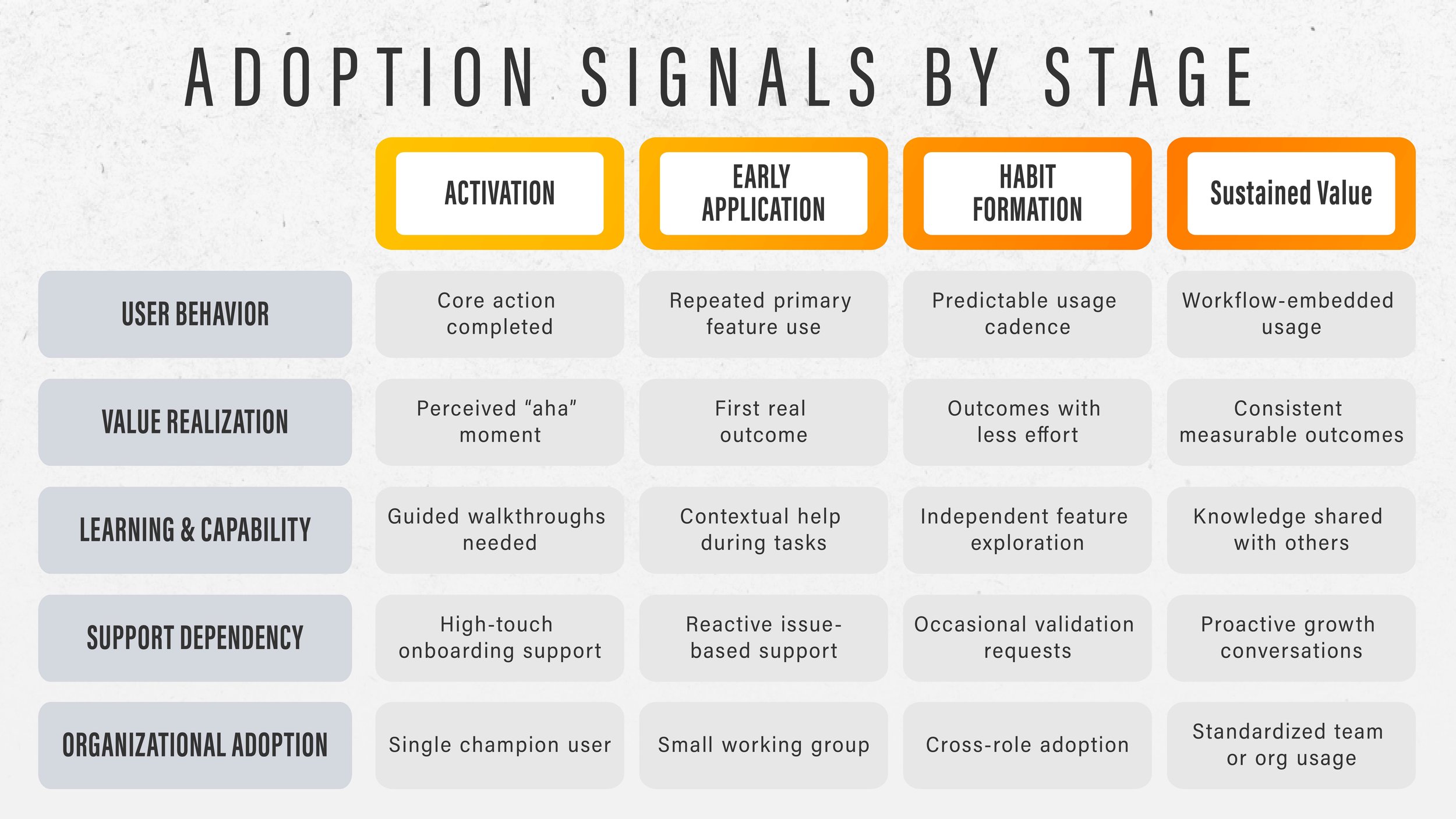
The framework organizes post‑onboarding support around stages of adoption, rather than product features or content types.
These stages reflect how confidence and usage typically develop over time:
building early confidence
achieving consistent success
expanding depth of use
reinforcing effective patterns
Each stage is supported by different types of learning and enablement, ensuring that customers receive what they need when it is most relevant.
Enablement & Support Strategy
Different moments in the adoption lifecycle require different forms of support. This framework intentionally balances multiple approaches, including:
self‑serve learning for reference and reinforcement
targeted guidance aligned to usage patterns
performance support at the point of need
facilitated touchpoints when context or complexity increases
A key design decision was recognizing that not every challenge requires training. In many cases, clarity, reassurance, or timely direction are more effective than additional content.
Measurement & Signals
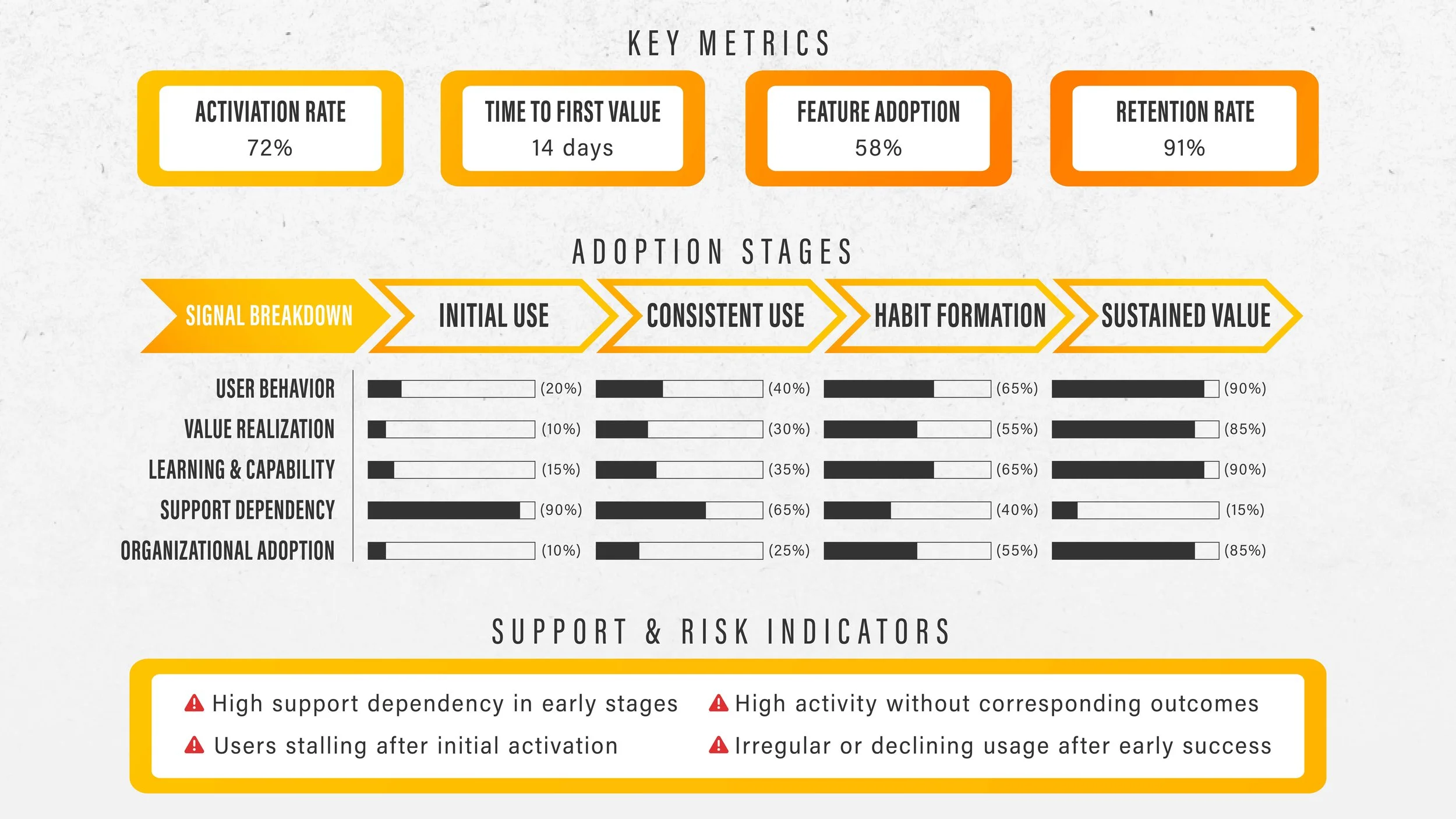
Rather than relying solely on completion metrics, this framework emphasized signals of adoption and confidence, such as:
consistency of usage over time
alignment between learning touchpoints and product behavior
reduction in reactive support requests
qualitative feedback from customers and internal teams
These signals helped inform where enablement was working and where additional support was needed.
Outcomes & Impact
A structured post‑onboarding adoption approach supports:
more consistent customer experiences
clearer ownership of adoption across teams
stronger alignment between learning and customer success
improved long‑term engagement and value realization
By treating adoption as an ongoing system, support becomes more intentional and less reactive.
Reflection
This work reinforced that adoption is not a phase—it is a relationship that requires thoughtful design over time.
When learning and enablement are aligned to real usage moments, customers feel supported without feeling overwhelmed. This framework continues to shape how I approach adoption, enablement, and long‑term success across learning and organizational contexts.