PulseCS
AI-Powered Customer Success Decision Intelligence
PulseCS is an AI-powered Customer Success decision intelligence system designed to help enterprise Customer Success Managers diagnose renewal risk, identify root causes, and generate executive-ready action plans from fragmented customer health data.
Rather than functioning as another chatbot, PulseCS applies a structured reasoning framework that transforms operational signals into prioritized business decisions, enabling Customer Success teams to focus on strategic customer outcomes instead of manual analysis.
AT A GLANCE
Role
Product Designer • AI Workflow Architect • Customer Success Strategist
Timeline
Independent Product Case Study
Methods
Product Strategy, AI Workflow Design, Prompt Engineering, Decision Framework Design, Customer Success Strategy, UX Writing, Synthetic Data Modeling.
Designed using structured prompt engineering, synthetic enterprise datasets, decision framework architecture, and iterative validation across multiple customer scenarios.
Responsibilities
Product strategy
AI workflow design
Prompt architecture
Customer health framework
Decision logic
Synthetic data creation
Testing & validation
UX writing
WHY THIS PROJECT
After leading Customer Education and Customer Success initiatives for enterprise software organizations, I repeatedly saw Customer Success Managers spend more time gathering information than making decisions.
Customer health data existed—but it was scattered across CRM systems, product analytics, onboarding records, support platforms, and customer conversations. Preparing for an executive meeting often meant manually reviewing multiple dashboards before determining the next step.
PulseCS began as an exploration of how AI could reduce that administrative burden while preserving the strategic thinking of experienced Customer Success professionals.
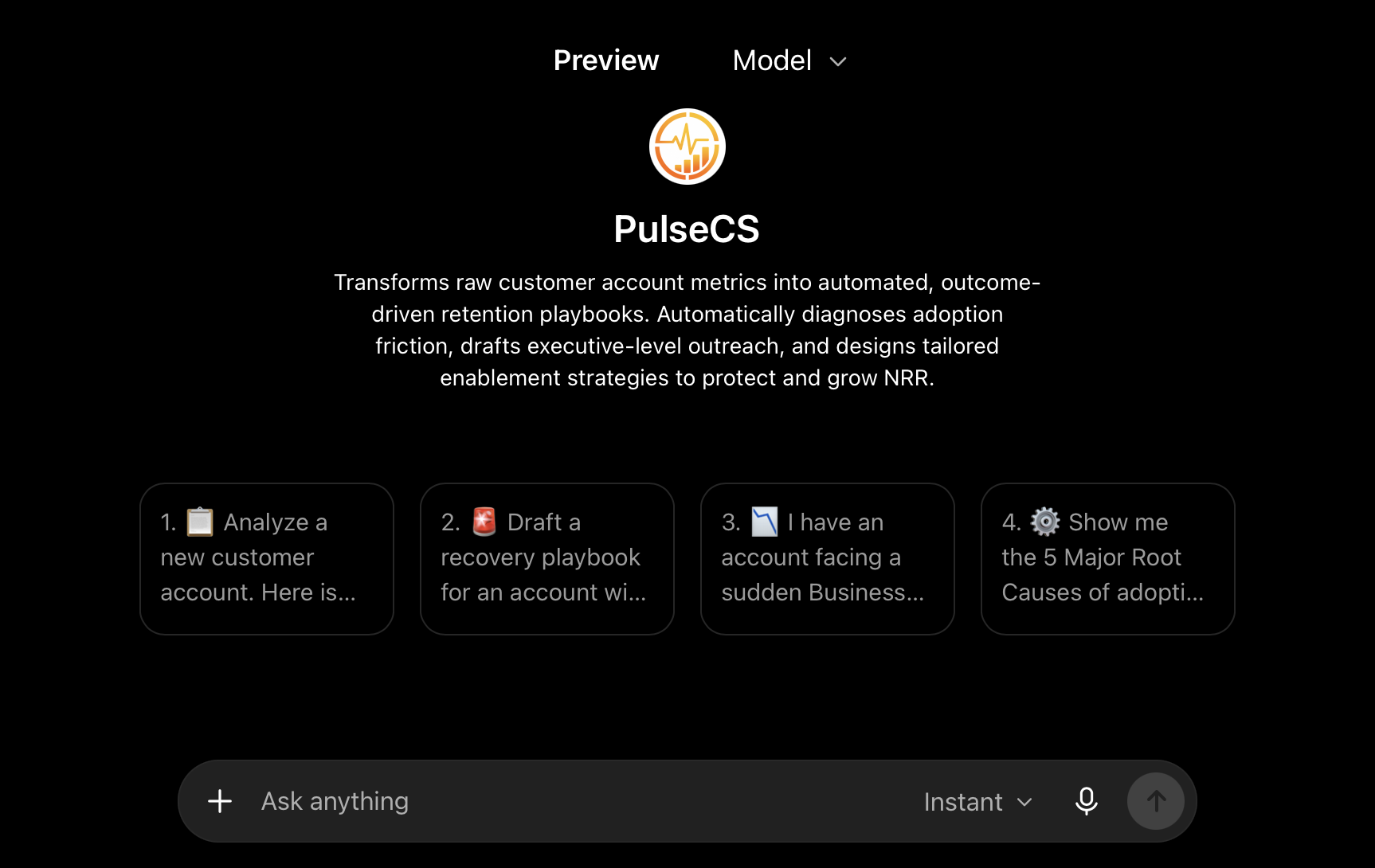
PulseCS welcome screen.
THE PROBLEM
Enterprise Customer Success teams manage dozens—or even hundreds—of accounts simultaneously. While organizations collect extensive customer health data, most platforms simply report individual metrics rather than helping teams understand what those metrics actually mean.
The challenge isn't collecting more data.
The challenge is synthesizing business context into confident, actionable decisions.
I wanted to explore whether AI could function as a strategic thought partner that diagnoses customer health, identifies root causes, and recommends practical next steps instead of simply generating summaries.
MY APPROACH
Rather than building another conversational chatbot, I designed PulseCS as a structured decision intelligence system.
The platform evaluates multiple customer health signals simultaneously—including adoption, engagement, executive relationships, support history, onboarding progress, customer sentiment, and renewal timing—to identify the dominant business risk before generating recommendations.
Every recommendation follows five guiding principles:
Diagnose before recommending
Prioritize business impact
Explain the reasoning
Generate actionable playbooks
Support—not replace—the Customer Success Manager
DESIGNING THE DECISION FRAMEWORK
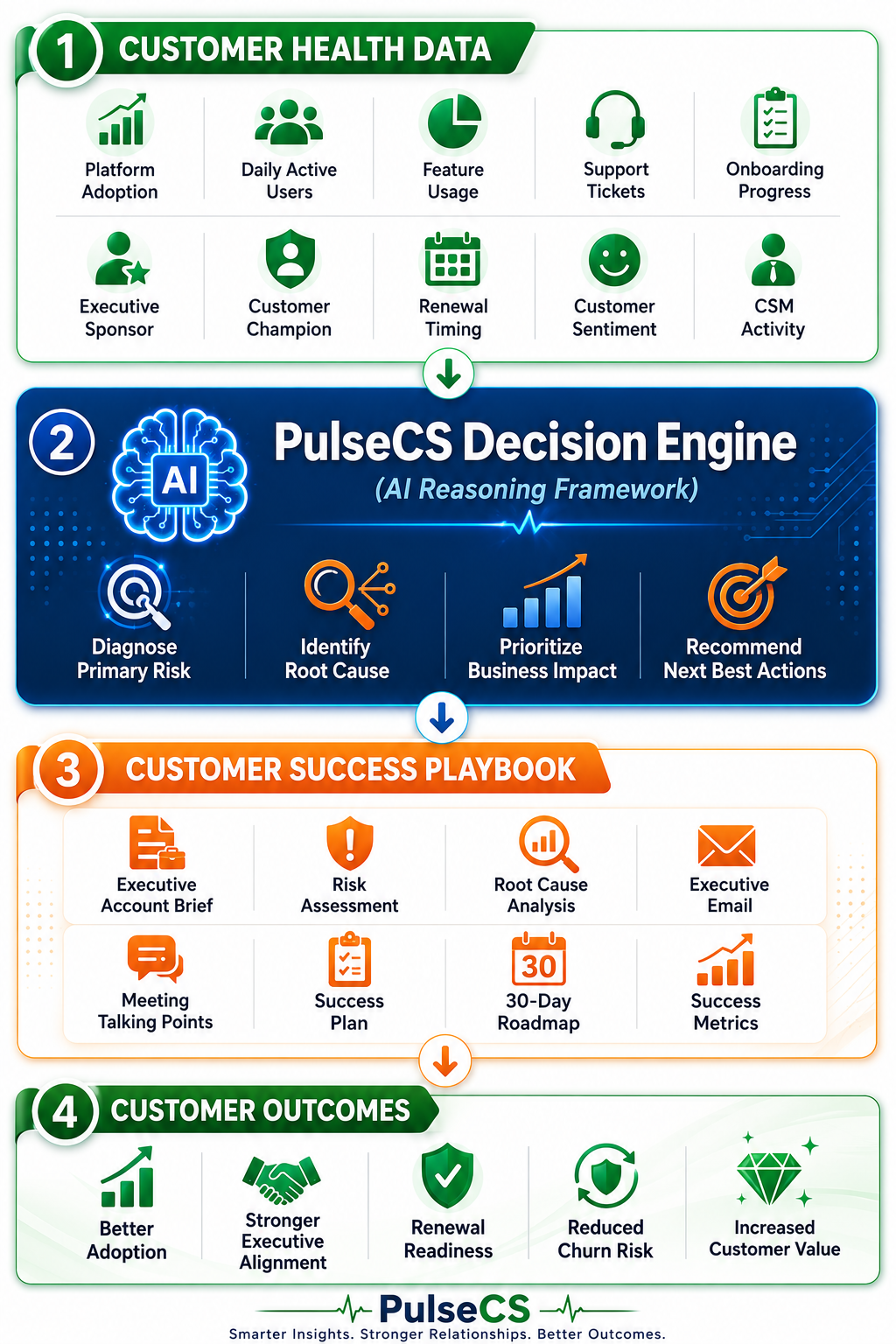
At the center of PulseCS is a structured reasoning framework that mirrors how experienced Customer Success leaders evaluate complex accounts.
Instead of reacting to isolated health metrics, the platform combines multiple business signals to determine the primary source of customer friction, prioritize the greatest business impact, and generate tailored Customer Success playbooks.
The workflow moves through four stages:
Customer Health Data
AI Decision Engine
Customer Success Playbook
Customer Outcomes
BUILDING THE CUSTOMER DATASET
Because no production customer data could be used, I created a synthetic enterprise dataset representing more than 1,000 anonymized customer accounts.
Each account included combinations of:
Platform adoption
Product usage
Support history
Executive sponsorship
Customer champions
Renewal timing
Onboarding completion
Customer sentiment
CSM engagement
This allowed PulseCS to validate decision logic across a wide range of customer scenarios while ensuring every recommendation reflected unique business conditions rather than repetitive AI responses.
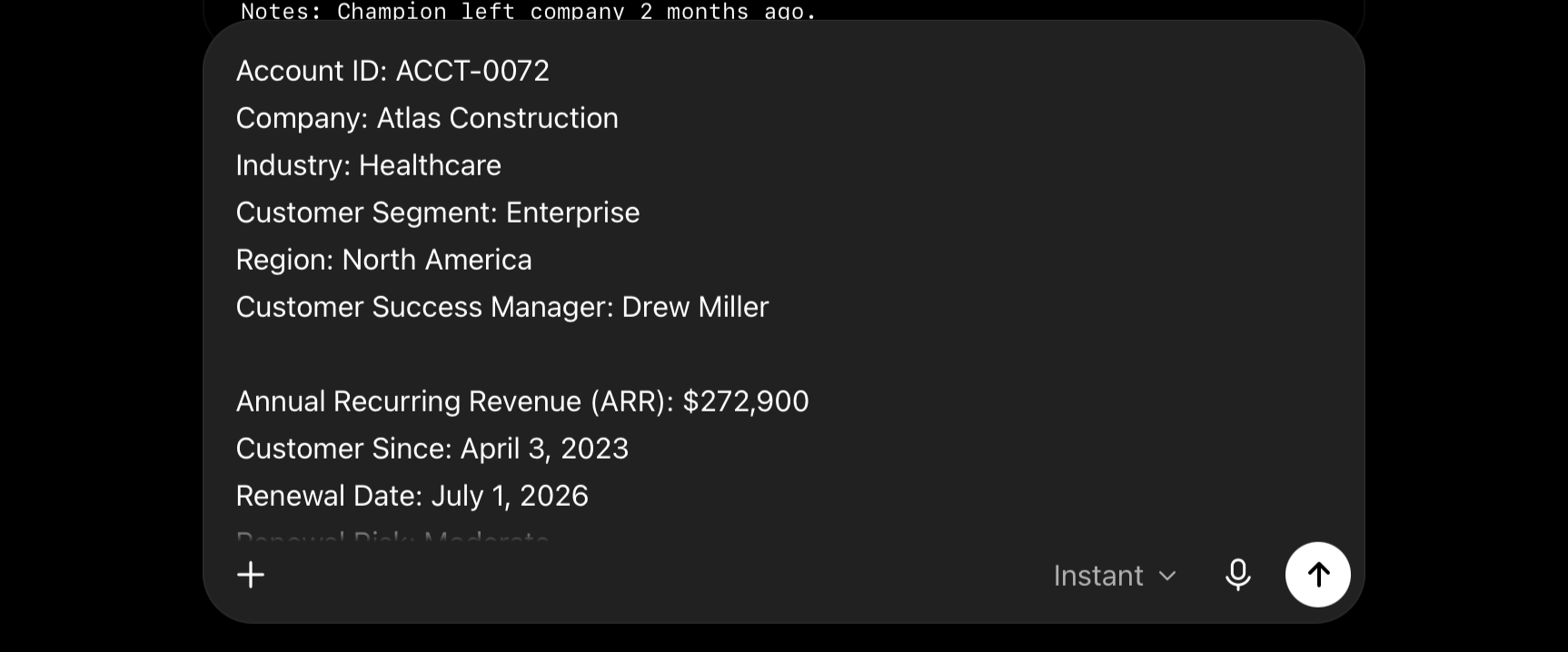
Starting with a complete customer health profile.
TESTING & VALIDATION
The framework was evaluated across multiple customer scenarios, including:
Healthy customers
Adoption challenges
Executive disengagement
Technical friction
Renewal risk
The objective wasn't simply generating different responses—it was verifying that different customer conditions consistently produced different diagnoses, recommendations, communication plans, and success strategies.
AI-Generated Outputs
Rather than providing a health score alone, PulseCS generates an actionable customer recovery plan.
Outputs include:
Executive Risk Assessment
Executive Account Brief
Root Cause Analysis
Executive Talking Points
Executive Email
Strategic Workshop Outline
30-Day Success Roadmap
Success Metrics
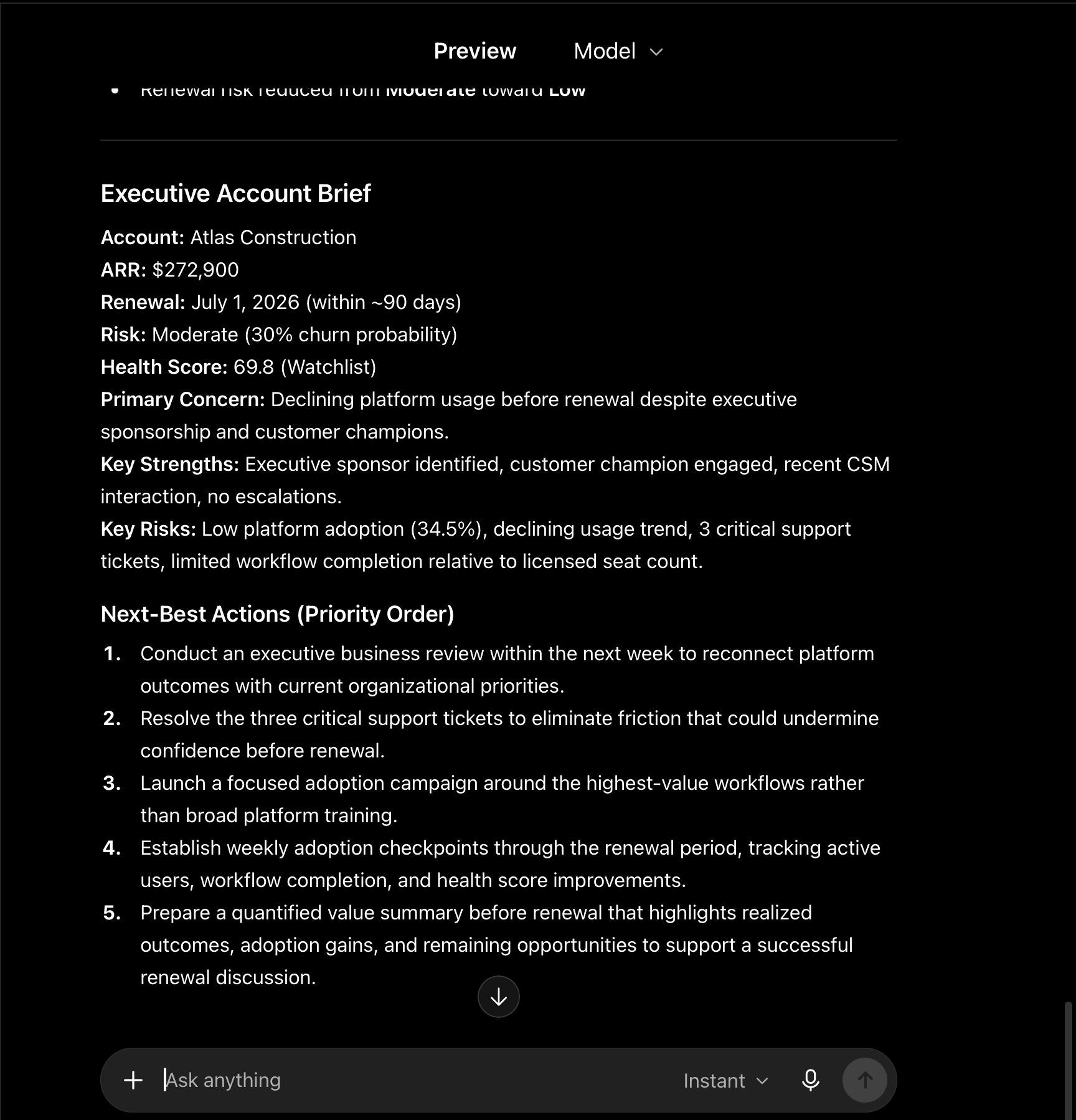
Understand the Account in Under a Minute
Instead of manually reviewing dashboards and CRM records, PulseCS consolidates customer health, business context, renewal risk, and recommended priorities into a concise executive-ready briefing.
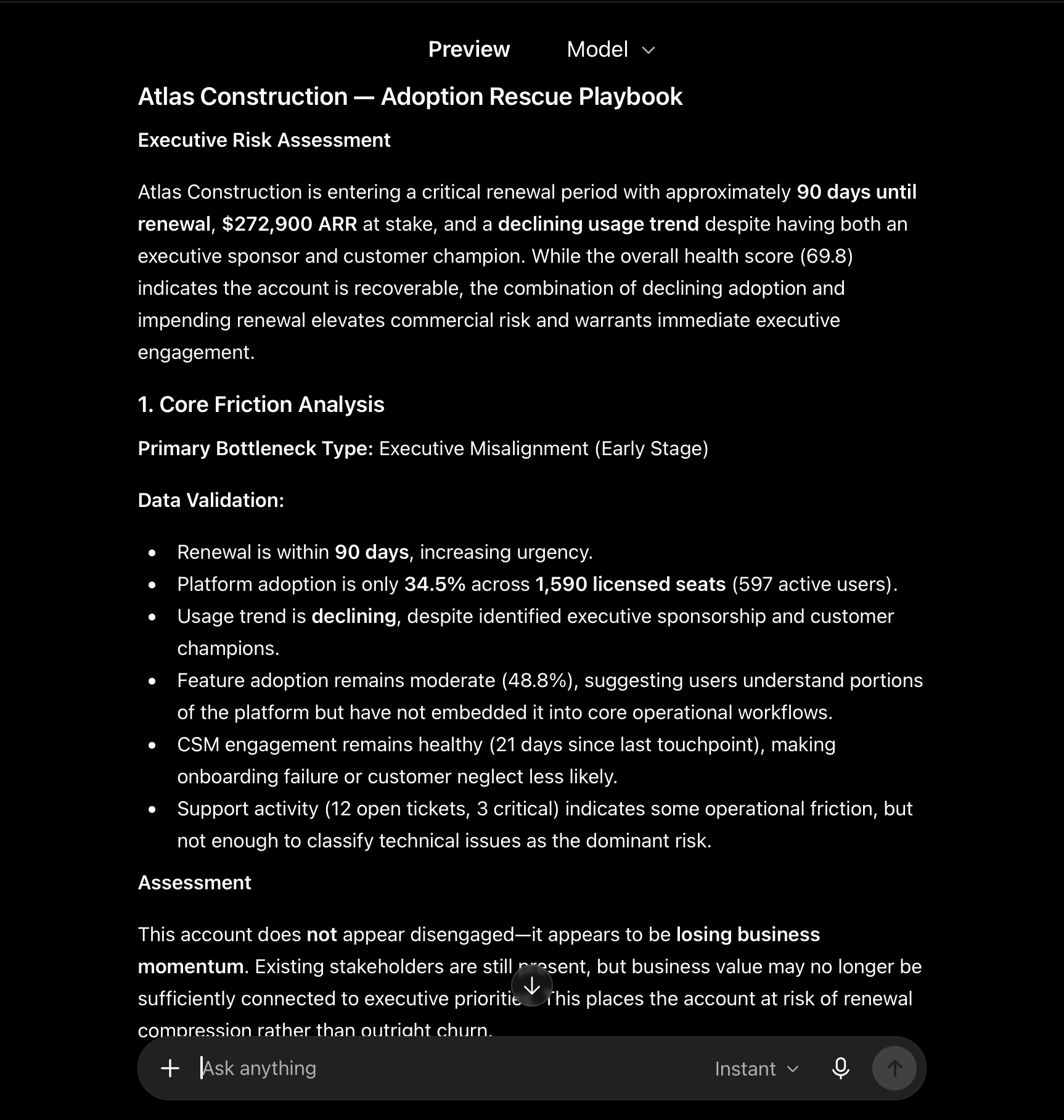
Identify the Root Cause Behind Customer Risk
PulseCS doesn't stop at reporting declining adoption. It evaluates customer signals together to determine the underlying business issue, explain its reasoning, and recommend where Customer Success should focus first.
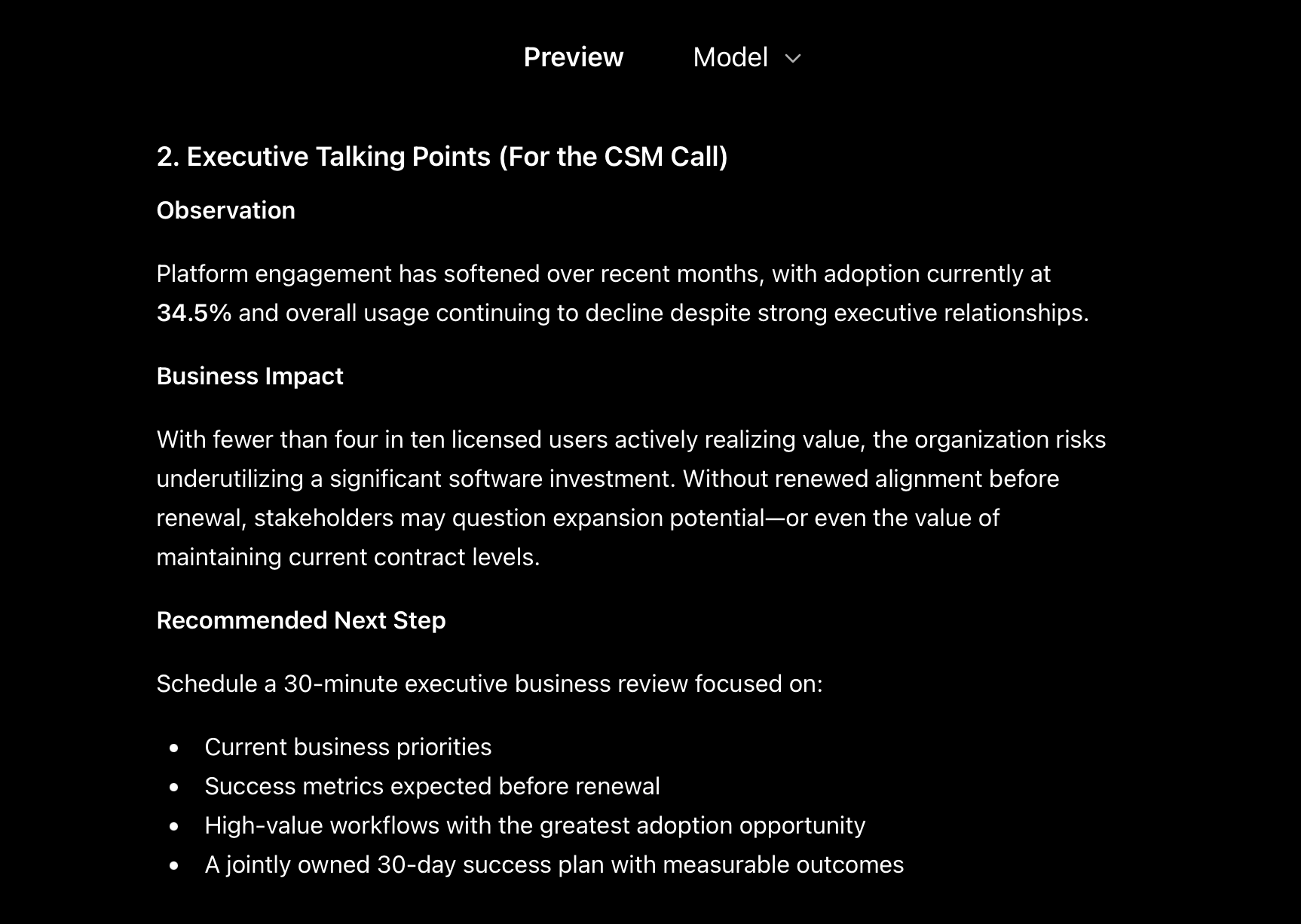
Prepare Every Customer Conversation with Confidence
Rather than starting from a blank page, PulseCS generates executive talking points that connect customer behavior to business outcomes, making strategic conversations faster and more consistent.
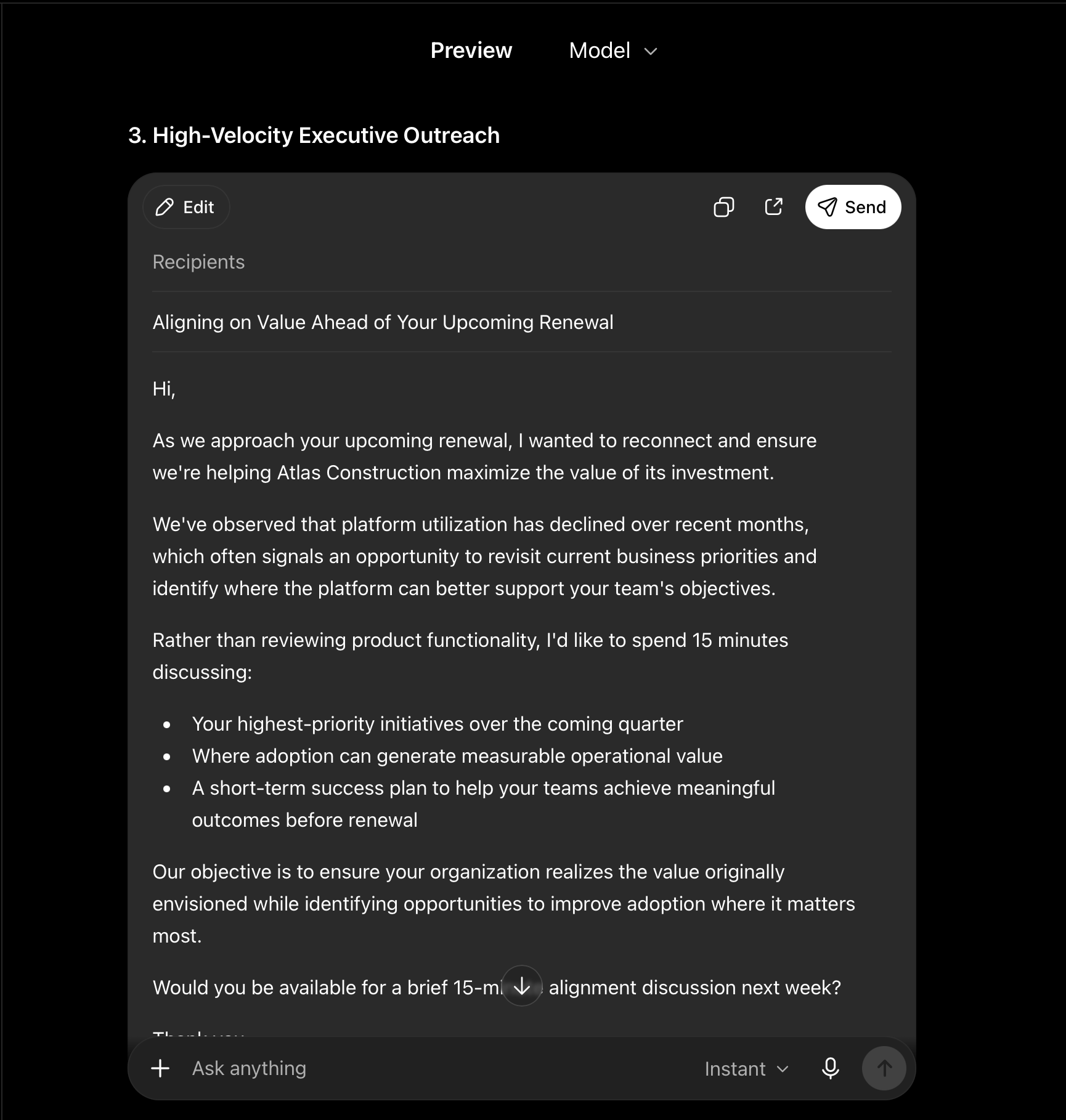
Turn Insight into Executive Action
PulseCS drafts personalized executive outreach based on each customer's specific challenges, helping Customer Success Managers engage stakeholders before renewal risk becomes churn.
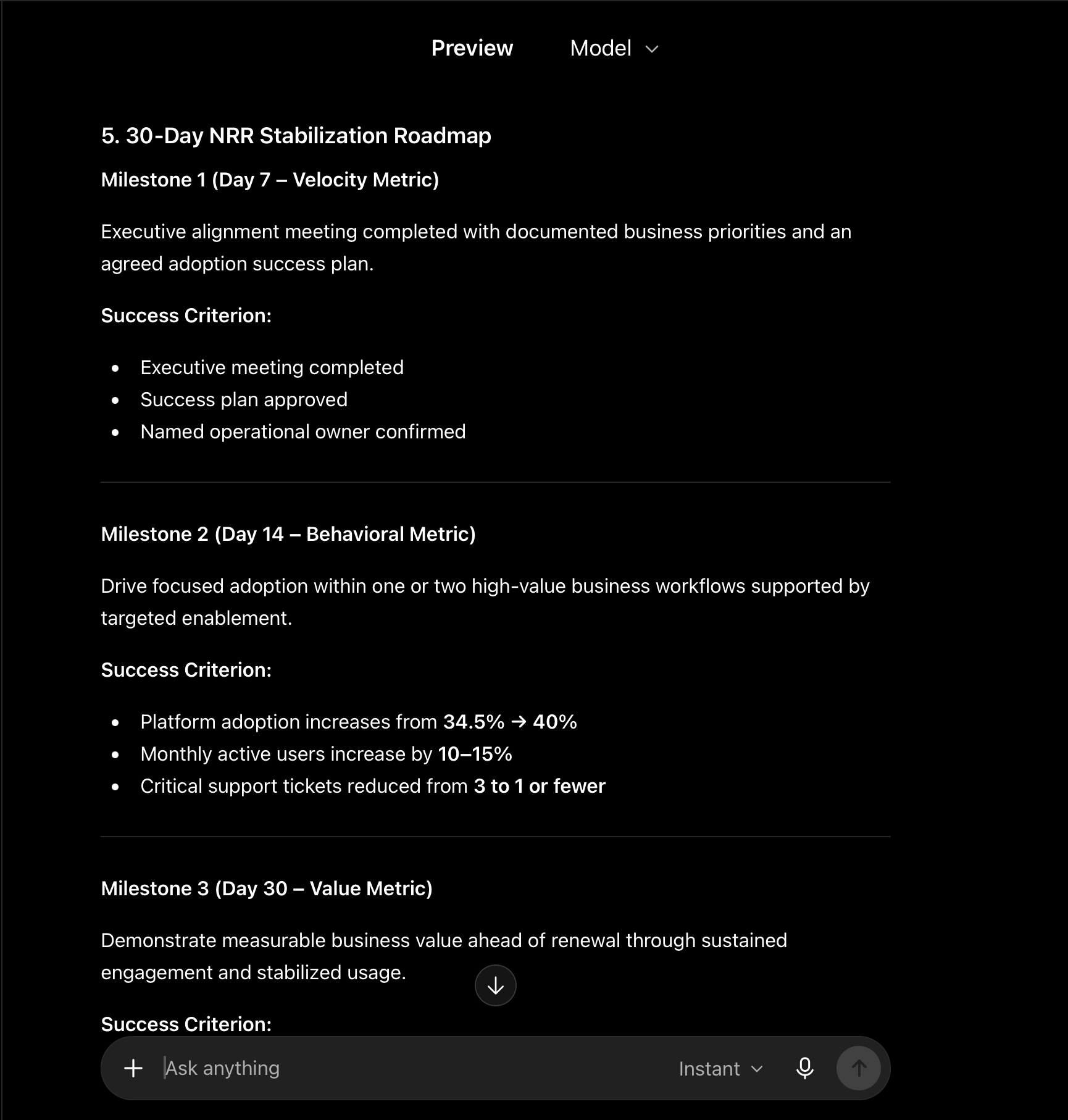
Create an Actionable Recovery Plan
Instead of generic recommendations, PulseCS produces a measurable 30-day success roadmap with milestones, ownership, and success metrics designed to improve adoption before renewal.
CUSTOMER SUCCESS PLAYBOOK
Once PulseCS identifies the primary business risk, it generates a complete Customer Success playbook rather than a single health score.
Outputs include:
Executive Account Brief
Risk Assessment
Root Cause Analysis
Executive Talking Points
Executive Email
30-Day Success Roadmap
Success Metrics
The goal is to reduce administrative effort while giving Customer Success Managers practical, executive-ready deliverables they can immediately use with customers.
OUTCOMES
Although developed as a prototype, PulseCS demonstrates how AI can move beyond content generation to become a practical decision-support system for Customer Success organizations.
Potential benefits include:
Faster account preparation
More consistent customer health evaluations
Better executive communication
More focused intervention planning
Stronger renewal readiness
Reduced administrative effort
Greater focus on customer outcomes
Most importantly, PulseCS shifts Customer Success from reacting to isolated metrics toward making informed, context-driven business decisions.
REFLECTION
The biggest lesson from this project was that successful AI products are less about generating content and more about structuring expert reasoning.
Designing the decision framework—not writing prompts—became the product's greatest differentiator.
This project reinforced that effective AI experiences combine domain expertise, systems thinking, and thoughtful workflow design to augment human decision-making rather than replace it.
SKILLS DEMONSTRATED
AI Product Design
Product Strategy
AI Workflow Design
Decision Framework Design
Customer Success Strategy
Prompt Engineering
Systems Thinking
Customer Journey Mapping
Executive Communication
UX Writing
Workflow Automation
AI Prototyping